Okay, so you’ve decided what you want to grow. You’ve bought the seeds. You’ve got the seedlings. And then comes the BIG question. How much must I actually plant? Because let’s be honest, it is VERY easy to get carried away. You open a packet of lettuce seeds, they’re absolutely tiny, so you sprinkle a few extra… and a few extra… and suddenly you are raising 47 lettuce seedlings for a family of four.
Been there. So today I want to break this down in a really simple way. And before we even get to numbers, there is one thing I want you to do.
Go and look in your fridge. Seriously. Open your fridge and have a look. What vegetables does your family actually eat? Because there is absolutely no point in growing 12 beautiful kale plants if everyone in your house suddenly disappears when kale is served for dinner. Some families go through onions like water. Some children eat peas straight from the plants before they ever make it into the kitchen. Some of us use spinach in absolutely everything. And then there’s zucchini. You think you need six plants. You do not need six plants. Trust me. 🙂
So before you work out how much space you need or how many seedlings to buy, start with what your family actually eats. Even better, look at your grocery shopping for a month. What are you buying again and again? THAT is what I would start growing.
OKAY TASH, BUT GIVE ME SOME NUMBERS!
Fine. Here we go. But please remember these are guidelines. Your family might eat twice as much spinach as mine. You might make tomato sauce and preserve tomatoes for winter. Maybe you don’t eat beetroot at all. So use this as a starting point and then adjust it as you get to know your garden.
LET’S START WITH THE GREENS
For lettuce, start with around 2–4 plants per person. But don’t plant them all at once. If there are four of you, I wouldn’t necessarily go and plant 16 lettuces today. Plant a few now. Then another few in two or three weeks. Then another few. Because otherwise you know exactly what’s going to happen. They’re all going to be ready together. You’ll eat lettuce for breakfast, lunch and dinner for a week and then have absolutely nothing for the next month.
For spinach or Swiss chard, around 4–6 plants per person is a good starting point. The lovely thing about Swiss chard is that you don’t harvest the whole plant. Pick the outside leaves and let the plant continue producing. Kale? Around 2–3 plants per person is plenty for most families. And Asian greens can be planted just like lettuce — a few plants every couple of weeks rather than one enormous planting.
NOW LET’S TALK CARROTS
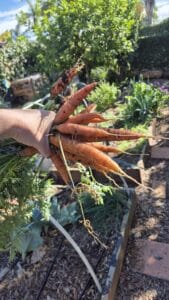
This is another one where we tend to get a little excited. Please don’t sow the entire carrot packet in one afternoon. You do not need 300 carrots ready on the same day. For carrots, you could work towards around 2–3 metres of row per person over the season. But break that up. Sow a little section now. Another section a few weeks later. Then another. The same goes for beetroot. Around 10–15 plants per person is a good starting point, but again, don’t necessarily plant them all together. Plant some now and another batch four to six weeks later.
We’re trying to create a garden that keeps feeding us — not a garden that gives us 87 beetroot on one Saturday morning.
AND THEN… ONIONS
This one always sounds crazy when you first hear it. Around 40–60 onion plants per person per year. FORTY TO SIXTY?! But wait. How many onions do you buy? If you use only one onion a week, that’s already 52 onions in a year. Suddenly it doesn’t sound quite so ridiculous, does it? This is exactly why looking at your shopping trolley is such a useful exercise. For leeks, around 10–15 plants per person is a good starting point.
WHAT ABOUT POTATOES?
For potatoes, you’re looking at roughly 10–15 seed potatoes per person if you want a decent household crop. Sweet potatoes? Around 5–10 slips per person. Again, adjust this according to how much space you have and how much your family actually eats. If potatoes are a huge part of your family’s meals, plant more. If you eat them once a month, don’t turn half your garden into a potato field because Tash told you to plant 15 per person.
Common sense always wins.
CABBAGE, BROCCOLI AND CAULIFLOWER
Around 2–4 plants per person is a nice starting point for cabbage, broccoli, cauliflower and Brussels sprouts. But here’s something I would definitely do, stagger them. For a family of four, you probably don’t need 16 cabbages becoming ready at exactly the same time. Plant a few. Then plant another batch later if your season allows it. Because there is only so much coleslaw one family can eat.
NOW WE GET TO THE SUMMER GOODIES
Tomatoes? Around 2–4 plants per person. BUT. Before you go and plant 16 tomato plants for a family of four, think about what you’re going to do with them. Do you preserve tomatoes? Make sauce? Bottle them? Give them away? Then brilliant — plant more. If you just want tomatoes for salads and sandwiches, you probably need far fewer. And cherry tomatoes are a different story altogether. One healthy cherry tomato plant can produce an unbelievable amount. For most households, 1–2 cherry tomato plants can already keep you very busy.
Peppers? Around 2–3 plants per person.
Chillies? Honestly, 1–2 plants per household can be plenty unless you eat loads of them.
Eggplant and cucumbers — around 1–2 plants per person.
AND NOW WE NEED TO HAVE A SERIOUS CONVERSATION ABOUT ZUCCHINI
If you’ve never grown zucchini before, you might look at the little seedling and think: “Ag shame. I’ll plant four.” Don’t!!
A happy zucchini plant can PRODUCE. For most households, one or two plants can be more than enough. The same goes for pumpkins. And for butternuts, around 2–3 plants per household can give you a lovely harvest if they are happy. Just remember that pumpkins and butternuts need space. They don’t politely stay where you planted them. They go exploring.
WHAT ABOUT PEAS AND BEANS?
For peas, around 10–20 plants per person. Bush beans, around 5–10 plants per person. Climbing beans, around 2–4 plants per person. But here’s where I want you to remember our succession planting. Let’s say you’re a family of four. You decide you want 40 bush bean plants. Please don’t plant all 40 this weekend. Plant 10. Then another 10. Then another 10. And another.
Now, instead of drowning in beans for two weeks, we’re trying to create a steady harvest over a much longer period. THAT is the goal.
BUT TASH, I DON’T HAVE SPACE FOR ALL OF THIS!
Good! Because you don’t need to grow everything.
I think this is where people sometimes make vegetable gardening far more complicated than it needs to be. You do NOT have to become completely self-sufficient in your first season. You don’t need potatoes, onions, carrots, broccoli, tomatoes, peppers, beans, peas, pumpkins and 14 different herbs all growing at once.
Start with five things. Actually, start with three if that’s what your space allows. Ask yourself, what do we buy every single week? Maybe it’s lettuce. Spinach. Tomatoes. Herbs. Spring onions.
Start there. Imagine if your first goal was simply, “For the next three months, I don’t want to buy lettuce.” That’s a fantastic goal. Then maybe next season you add something else. This is how a productive garden grows. Slowly.
AND PLEASE WRITE THINGS DOWN
This is one of the best things you can do. Write, 2 September – planted 8 bush beans. Then later, this wasn’t enough. Or… WHAT WAS I THINKING? We have beans everywhere.
Because after a season or two, you’ll start learning your family’s numbers. You’ll know that four spinach plants aren’t enough. You’ll know that you absolutely do not need two zucchini plants ever again. You’ll know how many tomatoes you actually use. And THAT information is far more useful than any generic planting chart. Because it comes from your garden and your kitchen.
SO HERE’S YOUR INFORMATIVE WEDNESDAY CHALLENGE
Go and look at your fridge. Or even better, look at your grocery receipts. Write down the five vegetables you buy most often. Then choose ONE and ask could I grow enough of this that I don’t have to buy it? Start there.
You don’t need to feed your entire family from the garden tomorrow. Replace one thing from the shopping trolley. Then another. Then another. And one day you realise you’re walking outside with a basket thinking, what’s for dinner? And instead of opening the fridge, you’re looking at your garden.
Now THAT is why we grow food.
Guys, this is just a small section from our VanZylStead Guide to Growing Veggies [1]. If you found this helpful and want to go into much more detail, grab your copy of the guide. We’ve packed everything we’ve learnt over the years into one place — from soil, planning and planting to feeding, watering, pests, harvesting and so much more.
It really is the guide we wish we had when we started growing our own food. Everything you need to know to give yourself the best chance of success in the veggie garden — all in one guide. Grab your copy and keep it close this growing season.
Tash en die Familie
 [1]
[1]