Your Plant Is Wilting at Midday… Does It Really Need Water?
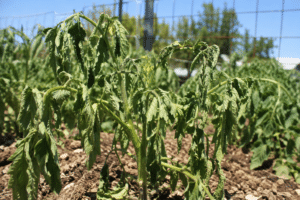
It is one of those hot afternoons. You walk into the veggie garden and suddenly your beautiful tomato plant looks absolutely miserable. The leaves are hanging. The whole plant looks tired. Yesterday it was perfectly happy, and now it looks as though it is begging you:
“WATER ME!”
So naturally, you grab the hose. But wait. A wilting plant does not always mean a thirsty plant. In fact, watering every time you see a plant wilt during the hottest part of the day can sometimes create more problems than it solves.
Let me explain what is actually happening.
On a warm, sunny day, plants are constantly moving water. Their roots take water up from the soil, it travels through the plant, and some of that moisture is released through tiny openings in the leaves in a process called transpiration. Think of it a little like the plant’s cooling system. But around midday, especially when it is hot, dry or windy, a plant can sometimes lose water through its leaves faster than its roots can replace it.
The result? Those lovely firm leaves start to droop. The plant looks thirsty. But there may actually still be plenty of moisture around its roots. This is what makes midday wilting so confusing.
Before you water, stick your finger into the soil. Not just over the surface. Push your finger roughly 5 cm down near the root zone. If it still feels cool and moist underneath, I would not automatically reach for the hose. Give the plant some time. Then go back into the garden later that afternoon or early evening when the temperature has dropped.
Has it picked itself up again? If those leaves are standing happily again it probably didn’t need you to rescue it at all. It was simply responding to the heat. And this is such an important gardening lesson, look at your soil, not only at your leaves.
When wilting DOES mean “please water me”
There is a big difference between a plant that droops for a few hours during the hottest part of the day and a plant that remains wilted.
I start paying much more attention when:
- the soil is dry several centimetres down;
- the plant is still wilted later in the afternoon or evening;
- it is already drooping early in the morning;
- the leaves are becoming dry or crispy;
- the plant isn’t recovering overnight;
- containers feel unusually light when lifted.
Those are much stronger signs that the plant may genuinely need water. And remember that containers and raised beds can dry out much faster than established plants growing directly in the ground.
But surely extra water can’t hurt?
Unfortunately, it can. One of the easiest mistakes to make in a veggie garden is loving our plants with the hose just a little too much. If we see wilted leaves at 1 pm and water, then see them wilt again tomorrow and water, and again the next day, we can end up keeping the root zone constantly wet.
Waterlogged soil contains less oxygen, and roots need oxygen too. Constantly wet conditions can contribute to poor root health and certain diseases. And there is another problem. Frequent little drinks can encourage shallow roots. I would much rather encourage my plants to develop a good root system than teach them that water will always be waiting in the top few centimetres of soil.
Deep watering beats panic watering
Instead of reacting to every droopy leaf, learn what is happening underneath the soil. When watering is needed, I prefer a good, deep watering that reaches the root zone. Then allow the soil to begin drying appropriately before watering again. Of course, there isn’t one watering schedule that works for every garden. Your soil type, temperature, wind, rainfall, mulch, plant size, containers and even where a bed sits in the garden will change how quickly it dries.
That is why I am always hesitant when someone asks “How many times a week should I water?” Your garden can answer that question much better than a calendar can.
Mulch makes a huge difference. This is also one of the reasons I love keeping soil covered. A layer of mulch helps reduce evaporation, protects the soil from direct sun and can help keep the root zone cooler.Pull the mulch aside on a hot afternoon and feel the soil underneath. You might be surprised by how cool it still is. That little layer of protection can make an enormous difference during summer.
There is one more thing I want you to check…
If a plant is wilting even though the soil is wet, don’t assume that more water is the answer. Stop and investigate. Could the soil be waterlogged? Could drainage be poor? Are the roots damaged? Has the plant recently been transplanted? Has something disturbed the roots? Is there a disease affecting the plant?
Sometimes a plant wilts because the roots cannot take up water properly, not because there isn’t enough water available. Adding more water in that situation won’t solve the real problem.
Next time you see one of your plants dramatically wilting at midday, resist the urge to grab the hose immediately. Check the soil!
Want to understand your garden a little better? This is exactly what we love unpacking in our VanZylStead Digital Magazines — the everyday garden questions that can make the difference between guessing and actually understanding what your plants are telling you. From watering and feeding to pests, soil, seedlings and seasonal growing, our magazines are packed with practical advice you can use in your own backyard.
Because the more you understand your garden, the easier growing becomes.
Explore our Digital Magazines and keep learning with us. [1]
Happy Gardening Friends
Tash en die Familie