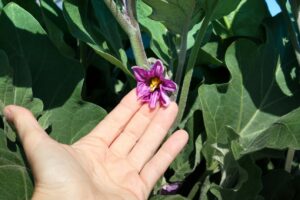
Should you remove the first flowers from young vegetable plants?
You bring home a beautiful little tomato, pepper or aubergine seedling from the nursery and notice something exciting: It already has flowers! Surely that’s a good thing? Flowers mean fruit is coming. But then someone tells you to pinch those first flowers off. Wait… what?
It sounds completely backwards. We’ve spent weeks raising these plants because we WANT them to flower and produce vegetables. So why would we deliberately remove the very first flowers? The answer is: sometimes it can help — but definitely not always.
First, why would you remove flowers at all?
A young plant has a limited amount of energy. It needs that energy to grow roots, produce leaves and stems, flower, and eventually develop fruit. When a very small plant starts flowering — particularly while it is still in a seedling tray or small nursery pot — it may begin putting energy into reproduction before it has developed the strong root system and plant structure needed to support a good crop later.
Think of it this way: Before asking the plant to produce, we sometimes want it to build the factory first. A strong root system, healthy leaves and sturdy stems give the plant a much better foundation for everything that comes afterwards. But this doesn’t mean we should walk through the vegetable garden removing every flower we see.
Peppers
Peppers are probably the vegetable where you’ll hear this advice most often. A young pepper plant can start producing flowers while it is still quite small. Sometimes you’ll even buy a tiny pepper plant from the nursery with a little pepper already hanging from it. Very cute. But that tiny plant is now trying to grow roots, leaves AND a fruit at the same time.
If your pepper plant is still small, root-bound, recently transplanted or hasn’t established itself properly yet, removing those first few flowers can give it a little breathing room. Let the plant settle in. Let those roots grow. Let it develop some size. Once the plant is actively producing new growth and looks strong, leave the flowers and let it get on with producing your peppers. You don’t need to keep removing flowers for weeks.
Aubergines
I take a similar approach with aubergines. A small aubergine plant carrying a fruit very early can put quite a lot of energy into developing that one fruit. If I’ve just planted a small seedling and it’s already flowering, I’ll look at the plant before deciding what to do. Is it strong and actively growing? Or is it a little plant with only a few leaves that has just been transplanted? If it’s the latter, I would rather sacrifice an early flower or two and allow the plant to establish properly.
Once it is growing strongly, the flowers stay.
And then we have tomatoes…
This is where I wouldn’t automatically follow the same advice. Tomatoes naturally begin producing flower trusses as they mature, and if you’ve planted out a healthy, appropriately sized tomato seedling, you generally don’t need to remove its first flowers simply because they’re the first ones.
Those flowers could become your first tomatoes! If the plant is healthy, growing well and has been planted into good soil with enough space, sunlight and water, I would usually leave them alone. There are exceptions. If you’ve bought a very stressed little tomato plant that’s been sitting root-bound in a tiny pot and is already flowering, I might remove the flowers while I transplant and rehabilitate it.
But that’s because of the condition of the plant, not because tomato plants somehow need their first flowers removed. That’s an important difference.
Don’t follow gardening rules blindly
This is one of those gardening tips that gets repeated until it starts sounding like a rule: “Always remove the first flowers.” Gardening rarely works like that. Instead, look at the plant in front of you.
Ask yourself: Is this plant big and strong enough to support fruit? If you’ve just planted a tiny pepper or aubergine seedling that’s struggling to establish itself, removing a couple of early flowers isn’t going to ruin your harvest. It may actually help the plant concentrate on establishing itself first.
But if you have a vigorous, healthy plant that’s growing beautifully? You don’t need to keep pinching flowers simply because someone on the internet told you to.
What if my seedlings are flowering before I’ve planted them out?
This is something worth paying attention to. When seedlings start flowering while they’re still sitting in small containers, it can be a sign that they’ve been kept in those pots for quite a while. Check the roots. If they’re circling tightly around the inside of the pot, the plant may be root-bound. Get it planted into its final growing position, water it thoroughly and give it time to establish.
For peppers and aubergines, I would consider removing early flowers or tiny fruit from a particularly small or stressed plant. For a healthy tomato seedling, I’d be much less concerned about a flower truss.
What about courgettes, cucumbers and pumpkins?
Different story. I wouldn’t routinely remove their first flowers. In fact, don’t panic when your courgettes, cucumbers and pumpkins start producing flowers but you aren’t getting fruit immediately. Members of the cucurbit family produce separate male and female flowers, and it’s common for male flowers to appear first. The plant isn’t broken. It’s simply getting started. Later you’ll begin seeing female flowers — they’re the ones with the tiny immature fruit sitting directly behind the flower. And then our pollinators have an important job to do.
So, should you pinch that flower off?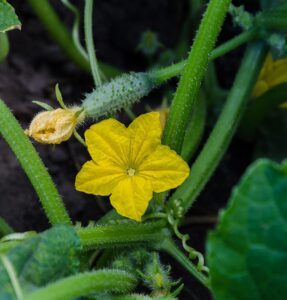
Before your fingers go anywhere near it, look at the whole plant.
Small, stressed, newly transplanted pepper or aubergine? Removing the first few flowers may be worthwhile. Strong, established pepper or aubergine? Leave them. Healthy tomato plant? Usually leave the flowers alone.
A stressed, root-bound tomato that’s flowering while still tiny? Deal with the stress and consider removing those early flowers while the plant establishes.
Pumpkin, cucumber or courgette? Leave the flowers and let the plant do its thing.
The important lesson isn’t really whether to pinch a flower. It’s learning to read your plants instead of gardening according to blanket rules. Sometimes the best thing you can do for your vegetable garden is actually very simple. Look at the plant. Look at how it’s growing.
And then decide what that particular plant needs.
Learn to read your veggie garden
The important lesson isn’t really whether to pinch a flower. It’s learning to read your plants instead of gardening according to blanket rules. Sometimes the best thing you can do is stop, look at the plant in front of you and ask: Is it growing strongly? Is it stressed? What are the leaves telling me? What is happening in the soil? Does it actually need feeding, more water — or perhaps less?
The more you understand what your plants are telling you, the easier growing food becomes. And that is exactly why we created the VanZylStead Guide to Growing Veggies. We wanted to create the guide we wished we’d had when we started growing food at home — something practical that takes you through the whole journey, from understanding and preparing your soil, planning your veggie garden and starting seeds, right through to caring for your plants, watering, feeding, dealing with problems and eventually harvesting your own food.
Whether you’re planting your very first veggie bed or you’ve been growing for years but still find yourself wondering “What am I doing wrong?”, the Guide is there to help you understand why we do things, not simply tell you what to do.
Because you don’t need to know everything to grow food. You just need to know what to look for.
Get your VanZylStead Guide to Growing Veggies and grow with us this season. [1]
Happy Gardening Friends
Tash en die Familie
 [1]
[1]