Raised Beds, In the Ground or Containers – Where Should You Grow?
When people decide they want to start growing vegetables, one of the first questions is usually: Where am I actually going to grow them? Do I need raised beds? Can I simply plant into the soil I already have? Or should I start with containers? And I think this is where we sometimes make vegetable gardening far more complicated — and expensive — than it needs to be.
When we started growing food at VanZylStead more than 11 years ago, I certainly didn’t have everything figured out. Our garden wasn’t designed from day one with beautiful raised beds and perfect soil. We started with what we had, made mistakes, changed things, improved our soil and slowly figured out what worked in our space. And that is exactly what I want you to do. Before you order raised beds or buy bags and bags of soil, go outside and look at what you already have.
It really does start with the soil
I say this all the time: if you want to grow healthy vegetables, you need healthy soil. Your soil is where your plants find water and nutrients, where their roots establish themselves and where an entire living ecosystem exists beneath the surface. But here’s the important part: having poor soil now doesn’t mean you’re stuck with poor soil forever. Soil can be improved. And before you decide that you need raised beds, I want you to find out what kind of soil you already have.
Take a spade and dig down about 20–30 cm. Get your hands into it. Don’t just look at the surface. Is it dark and crumbly? Does it feel gritty and fall apart in your hands? Is it sticky and heavy? Is it so compacted that you can hardly get the spade into it? Look for worms. Smell the soil. See how much organic matter is there. You’re already learning something about your garden.
What is actually happening underneath your feet?
Natural soil is made up of different layers. At the top we have organic material — leaves, mulch, compost and decomposing plant matter. Underneath that is the topsoil, and this is the area we’re particularly interested in when we’re growing vegetables. Good topsoil is generally darker, contains organic matter and is full of biological activity. Below that you’ll find the subsoil, which is usually more compact and contains less organic matter, and eventually you’ll reach parent material and rock. As veggie gardeners, we’re mostly interested in what is happening in those upper layers because that’s where so much of our root activity takes place. And you’d be surprised how different the soil can be from one garden to another — or even from one part of your own garden to another.
Get to know YOUR soil
If your soil feels very gritty and water disappears almost as quickly as you apply it, you’re probably dealing with sandy soil. We have plenty of sandy soils around Cape Town, and people sometimes assume that means they can’t grow vegetables successfully. You absolutely can. Sandy soil simply needs help holding onto moisture and nutrients. Compost, organic matter and mulch become incredibly important. And it isn’t a once-off job. You keep adding organic matter and gradually build the soil.
Clay is almost the opposite. When it’s wet, it can be sticky and heavy. When it’s dry, it can become incredibly hard. Clay actually holds nutrients very well, but drainage and compaction can become a problem. Again, it doesn’t automatically mean you can’t grow in it. Compost and organic matter can transform soil over time. But if water sits around for hours or the ground becomes waterlogged during winter, that’s when I would seriously start considering raised beds.
If you’re lucky enough to have beautiful loamy soil that holds moisture but still drains well, use it! Please don’t cover perfectly good garden soil simply because you think a vegetable garden is supposed to have raised beds.
Do a simple drainage test
This is one of the easiest things you can do before deciding where to put your vegetable garden. Dig a hole approximately 30 cm deep, fill it with water and allow it to drain. Then fill it again and see what happens. If the water drains away reasonably well within an hour or two, that’s encouraging. If you’re still staring at a hole full of water several hours later, you probably have a drainage issue. And if the water seems to vanish almost instantly, your soil may be extremely sandy and free-draining.
Neither situation means you can’t grow vegetables. It simply tells you what you’re working with. You can also do a simple jar test by mixing soil and water in a clear jar, shaking it well and allowing it to settle. The heavier sand particles will settle first, followed by silt and then the very fine clay particles. It’s a great little experiment and gives you a better idea of what’s actually in your soil.
A basic pH test is useful too. Most vegetables are happiest in slightly acidic to neutral soil, roughly around pH 6–7. Now that you know what you’re dealing with, then you can decide how you want to grow.
So, should you plant straight into the ground?
If I had reasonably good soil, good drainage and enough space, I would absolutely consider growing directly in the ground. It’s the simplest option and often the cheapest. You don’t need to dig everything up and completely replace your soil either. I’m a big fan of building soil from the top with compost, organic matter and mulch and allowing nature to do much of the work for us.
Over time, soil changes. Earthworms move through it. Roots open pathways. Organic matter breaks down. Microorganisms get to work. The garden you have this season doesn’t have to be the garden you have three years from now. Growing in the ground is also wonderful when you want to grow bigger crops such as pumpkins, corn and other plants that need plenty of room. So don’t dismiss your existing soil before you’ve given it a chance.
When I would choose raised beds
Now, I love my raised beds. We use them extensively at VanZylStead and they work incredibly well for the way I garden. I grow quite intensively, so having defined growing areas makes planning, planting, feeding and managing the garden easier for me. Raised beds also allow you to have much more control over what you’re growing in. If your existing soil is badly compacted, very shallow or has serious drainage problems, creating a raised bed allows you to build a beautiful growing environment above it. They’re also lovely to work in. You can create neat pathways between them, you don’t walk on your growing soil and, depending on the height, they’re easier on your back.
But there’s one thing I really want people to understand:
A raised bed isn’t what makes your vegetables grow well. The soil inside it does. You can spend thousands of rands on beautiful raised beds and still struggle if you fill them with poor-quality soil. So if you’re investing in raised beds, put just as much thought into what you’re going to fill them with.
And don’t think they have to be incredibly deep
This is another question I get quite often. How high should my raised beds be? The answer depends on why you’re raising them in the first place. If you have decent soil underneath and you’re simply creating a defined growing area, you don’t necessarily need a very deep raised bed. Your plants can continue rooting into the soil below. But if you’re building over very poor ground, paving or an area where roots can’t easily move downwards, then the depth of your growing medium becomes much more important. Don’t just copy someone else’s raised bed dimensions. Think about what’s underneath yours.
What if you don’t have a garden? Grow in containers.
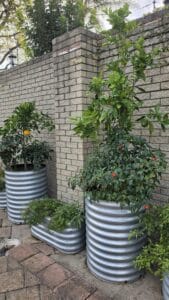
This is probably one of my favourite things about vegetable gardening. You don’t actually need a traditional garden to grow food. If you’ve got a sunny patio, balcony, courtyard or paved area, you’ve got growing space. I’ve seen people produce an incredible amount of food from containers. Tomatoes, peppers, chillies, aubergines, lettuce, herbs, strawberries, carrots and even potatoes can all be grown in pots.
The trick is choosing the right size container. One of the biggest mistakes I see is putting a plant that wants to develop a substantial root system into a tiny pot. A tomato might survive in a small container, but surviving and thriving are two very different things. Where possible, go bigger. Larger containers hold more soil, more nutrients and, importantly during our hot summers, more moisture. Because that is the downside of container gardening: pots dry out much faster than the ground. On a hot, windy summer’s day, a small container can dry out incredibly quickly. So if you know you’re not going to be able to water regularly, don’t create a garden consisting of dozens of tiny pots.
Before ALL of this, find your sun
There is actually something I want you to do before worrying too much about raised beds versus containers. Watch the sun. This is such an important step and one people often skip. Don’t decide where your veggie garden is going because that’s where you think the raised beds will look pretty. Spend a day watching your garden. Where does the sun hit first in the morning? Which areas stay sunny through the middle of the day? Where does your house cast shade in the afternoon? Tomatoes, peppers, aubergines, cucumbers, pumpkins and many of our other summer vegetables want plenty of sunshine. You could build the most beautiful raised beds and fill them with incredible soil, but if you’ve put them in the wrong place, you’re starting with a disadvantage. Sometimes the ugly corner of the garden is actually the best place to grow vegetables!
You also don’t have to choose just one
This is probably the most important thing I want you to take away from this. Your veggie garden doesn’t have to be either raised beds, or containers, or in-ground growing. Use all three if they work for you. You might grow tomatoes and leafy greens intensively in raised beds, put herbs in containers close to your kitchen and let pumpkins ramble through an in-ground section of the garden. That’s what gardening is about — learning to use your space. I would much rather see you successfully growing vegetables in five old containers than spending a fortune creating a picture-perfect veggie garden that becomes overwhelming.
Start with what you have
If your soil is good, use it. If it needs improving, start improving it. If your drainage is terrible, consider raising your growing area. If you’ve only got paving, get some containers. And if you’ve only got space for one pot, start with one pot. You don’t need the perfect setup before you can grow food. When we started VanZylStead more than 11 years ago, we didn’t know what our garden would eventually become. We simply started growing, learning and changing things as we went.
And I’m still learning from this garden. That’s the wonderful thing about growing your own food. Look at the space you have available.And then build your veggie garden around that.Not somebody else’s.
Want some help getting started? Our VanZylStead Guide to Growing Veggiestakes you through the entire process — from understanding and building your soil, planning your growing space and starting seeds, right through to feeding, watering, pest management, harvesting, container growing, composting and even incorporating chickens into your garden. It’s more than 210 pages of what we’ve learned from growing food in our own suburban garden for more than a decade.
Garden myth: Milk or baking soda for powdery mildew? Every growing season it happens in my garden too. Everything is growing beautifully and then one morning I walk past the cucumbers, pumpkins or courgettes and spot it… That first little white powdery patch on a...
My top 5 natural pest control hacks for the new growing season A new growing season means new seedlings, loads of growth and hopefully plenty of food coming from the garden. Unfortunately, it also means the pests are back! Over the years I have learned that pest...
Should you remove the first flowers from young vegetable plants? You bring home a beautiful little tomato, pepper or aubergine seedling from the nursery and notice something exciting: It already has flowers! Surely that's a good thing? Flowers mean fruit is...





0 Comments